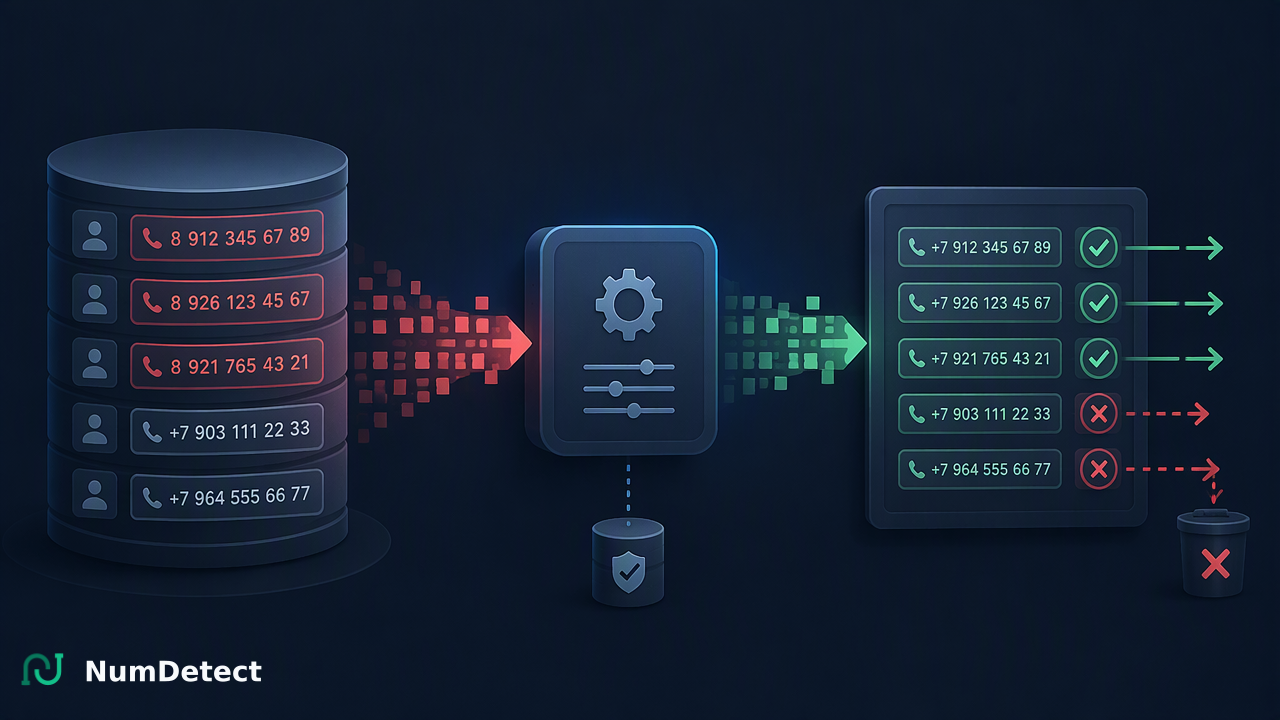
The Hidden Cost of Local Dialing Conventions in Data Pipelines
In many regional telecommunications markets, users are accustomed to local dialing plans that deviate from international standards. A common scenario involves the use of a leading '8' for domestic calls within Russia, which acts as a trunk prefix. While this is intuitive for human users dialing from a landline, it creates a significant technical hurdle when migrating legacy databases into modern, E.164-compliant backend systems.
When a system expects international formatting—specifically the +7 country code—but receives a local 8 prefix, the result is often a silent delivery failure. Downstream validation services, which rely on strict E.164 compliance to route requests or perform data hygiene, will reject these numbers as malformed. This article explores the engineering implications of this mismatch and provides a framework for normalizing regional datasets before they reach your processing pipeline.
The Symptom: Silent Rejection
The failure typically manifests during the ingestion phase of a bulk processing task. Imagine a scenario where a legacy CRM stores contact numbers as 89123456789. When this data is passed to an asynchronous bulk validation service, the system expects a standard E.164 format: +79123456789.
Because the input does not conform to the required international standard, the validation service may treat the entry as invalid. If your pipeline is configured to drop invalid rows silently, you lose contact data without triggering an error log. Even if the system logs the rejection, the root cause is often obscured by generic "malformed input" errors, leading engineers to suspect API connectivity issues rather than a fundamental data formatting mismatch.
Root Cause: The Trunk Prefix Conflict
The core of the issue is the difference between a national trunk prefix and an international country code. In the Russian numbering plan, the '8' is a prefix used to access the long-distance network. It is not part of the subscriber's unique identifier.
When you move from a local database to an internationalized service, you are essentially moving from a context-dependent numbering plan to a context-free one. E.164 requires the full country code and the subscriber number, stripped of any local trunk prefixes. Failing to normalize this data means your backend is attempting to route traffic to a non-existent country code (the imaginary country code '8') rather than the intended destination.
Engineering Recovery: Normalization Strategy
To resolve this, you must implement a pre-processing layer that sanitizes your data before it reaches the API. This is a critical step because bulk processing services generally require clean, standardized input to function correctly.
- Identify the Source Context: Ensure your database schema explicitly tags the origin of the phone number. If you are dealing with a mixed dataset, you cannot apply a blanket transformation.
- Regex-Based Normalization: For numbers identified as Russian, implement a transformation function. A common approach is to strip the leading '8' and prepend
+7.- Hypothetical Logic: If the string starts with '8' and has 11 digits total, replace the '8' with '+7'.
- Validation Before Submission: Before submitting a file to a bulk task, run a local validation script. Ensure that every number in your CSV or TXT file starts with a
+and follows the E.164 length constraints (maximum 15 digits). - Handling Edge Cases: Be aware of numbers that might already be correctly formatted. If your script blindly replaces the first character of every number, you risk corrupting numbers that are already in the correct
+7format. Always check the prefix before applying the transformation.
Trade-offs and Limitations
While normalization is necessary, it is not a panacea. One explicit trade-off is the risk of "over-normalization." If your dataset contains numbers from multiple regions, a naive script might incorrectly transform a number from a different country that happens to start with an '8'.
Furthermore, normalization does not guarantee that a number is currently active or reachable. It only ensures that the number is syntactically correct for the API to process. Once the data is normalized, you can use bulk services to perform tasks such as:
- Phone Number Validation: To confirm the number is in a valid format and potentially active.
- Number Activity: To obtain an activity signal for segmentation.
- Global Carrier Lookup: To retrieve numbering context, such as the region or city, which can help verify if the normalized number aligns with the expected geographic profile of your user base.
Operational Best Practices
When working with bulk processing APIs, remember that these services are designed for asynchronous workflows. You should not expect real-time, synchronous feedback for individual numbers.
- Task Management: Use the provided
POST /api/v1/bulk-tasksroute to submit your cleaned files. Ensure you are using the correctservice_typefor your needs, such asnumber_validation_batchorcarrier_batch. - Polling Strategy: Do not poll the status of your task more frequently than once every 30 seconds. Excessive polling can lead to unnecessary overhead.
- Idempotency: Utilize the
Idempotency-Keyheader when submitting tasks. This prevents duplicate processing if a network timeout occurs during the submission of your multipart form data. - Balance Management: Monitor your
balance_microsusing theGET /api/v1/balanceroute. Since bulk tasks reserve costs upon submission and release them upon failure, your balance will fluctuate based on the success of the processing, not just the submission.
Conclusion
The transition from legacy local dialing plans to international E.164 standards is a common hurdle in system migration. By treating data normalization as a mandatory pre-processing step—rather than an afterthought—you can prevent silent delivery failures and ensure that your downstream services receive the high-quality data they require.
Always validate your input locally before interacting with external APIs. By ensuring your data is compliant with international standards, you reduce the likelihood of rejected tasks and improve the overall reliability of your data pipeline. Remember that these tools provide specific signals for audience review and CRM hygiene; they are not a substitute for direct communication or a guarantee of reachability. Focus on the quality of your input, and the reliability of your downstream analysis will follow.
About the author
- Check phone number signals from one focused catalog of verification products.
Comments
Join the discussionNo comments yet. Be the first to comment.